Introduction
There have been many attempts by Muslims to ascertain the identity of Gog and Magog. In most cases, the evidence that are provided are purely from Islamic sources, and in some cases, some ancient Arabic stories are included, even though its authenticity cannot be verified.
What I intend to do here is to consider not only information from Islamic sources but also information from a Jewish source, in order to get a more complete set of information, from which to draw some conclusions. The Jewish source is important because, according to hadith, the Quran verses on Zul Qarnain were revealed following a question from Jews.
Zul Qarnain (the Two-Horned One)
The Quran starts the mention of Gog and Magog with the following verse:
And they ask you about the Two-Horned One. Say: "I will convey unto you something by which he ought to be remembered." (Quran 18:83)
According to the seerah1 of Prophet Muhammad, about five years into his prophethood, the Meccans wanted to determine whether Prophet Muhammad was really a Messenger of God, or a fake. So they sent a delegation to the Jews in Yathrib, because they considered the Jews to be better informed about the religion of Ibrahim. They asked the Jews how they might be able to ascertain the authenticity of Prophet Muhammad's prophethood.
The Jews in Yathrib then told the Meccans to ask Prophet Muhammad three questions. And if he was a real prophet, he would be able to answer them correctly.
One of the questions was about the mighty traveller who went East and West.
Notice that this question makes no mention of "the Two Horned One". Yet the Quran answered by mentioning "They ask you about the Two Horned One". This is no doubt done on purpose, to tell the Jews that Allah knows who they were referring to. And to understand this, we need to take a look at the Jewish scriptures, because their scriptures would be the source of their knowledge about this mighty traveller.
The following are some verses from the Jewish "Book of Daniel"2, Chapter 8:
And I lifted up mine eyes, and saw, and, behold, there stood before the stream a ram which had two horns; and the two horns were high; but one was higher than the other, and the higher came up last. I saw the ram pushing westward, and northward, and southward; and no beasts could stand before him, neither was there any that could deliver out of his hand; but he did according to his will, and magnified himself.And as I was considering, behold, a he-goat came from the west over the face of the whole earth, and touched not the ground; and the goat had a conspicuous horn between his eyes. And he came to the ram that had the two horns, which I saw standing before the stream, and ran at him in the fury of his power. And I saw him come close unto the ram, and he was moved with choler against him, and smote the ram, and broke his two horns; and there was no power in the ram to stand before him; but he cast him down to the ground, and trampled upon him; and there was none that could deliver the ram out of his hand.
And the he-goat magnified himself exceedingly; and when he was strong, the great horn was broken; and instead of it there came up the appearance of four horns toward the four winds of heaven. (Daniel 8:3-8)
Further down in the same chapter, the following explanation is given to Daniel:
The ram which you saw having the two horns, they are the kings of Media and Persia. And the rough he-goat is the king of Greece; and the great horn that is between his eyes is the first king. And as for that which was broken, in the place whereof four stood up, four kingdoms shall stand up out of the nation, but not with his power. (Daniel 8:20-22).
According to history, the first king of Persia and Media was Cyrus the Great. He was the person who united Persia and Media and he was called "two horns" because he was king over two countries. He was the first Achaemenid Emperor. His Kingdom was eventually invaded and ravaged by Alexander the Great from Greece. Then, after Alexander's death, his kingdom broke down into four smaller kingdoms, each led by one of Alexander's generals.
So, the narrative given by Daniel 8 is consistent with history.
There is also another reason for the Jews of Yathrib to choose Cyrus the Great in their question to Prophet Muhammad - Cyrus enabled the Jews to return to what they consider to be their promised land, from the Babylonian exile 3.
According to the Iran Chamber Society4:
"The victories to the East led him again to the West and sounded the hour for attack on Babylon and Egypt. When he conquered Babylon, he did so to cheers from the Jewish Community, who welcomed him as a liberator - he allowed the Jews to return to the promised Land."
Zoroastrianism
Since Cyrus was a Zoroastrian, this may be a good place to describe some of the Zoroastrian beliefs.
Zoroastrians believe in one God, whom they call Ahura Mazda (wise Lord). In other words, "There is no god but Ahura Mazda". He is compassionate, just, and is the creator of the universe. Some characteristics of Ahura Mazda are as follows:
- Omniscient (all knowing)
- Omnipotent (all powerful)
- Omnipresent (present everywhere)
- Inconceivable
- Unchanging
- Uncreated
- The Creator of life
- The source of all goodness and happiness
There is no difference between the above and Muslim beliefs.
God is worshipped as supreme. Just as Muslims worship God while facing the Kaabah, but we do not worship the Kaabah, Zoroastrians worship God while facing a source of light such as the sun or fire, but they do not worship the source of light. They worship God alone.
Zoroastrians worship God several times a day and they have a purification ritual called pādyāb (their form of wuduk). The ablution takes place as follows: The person first recites a prayer. Then he wets the two hands up to the wrists, including the palm and fingers, and washes his face, which is followed by wetting the right hand again and thrice washing the right foot from below the ankle. Then again he wets his right hand and thrice washes his left foot from below the ankle. Then he washes both his hands again up to the wrists and wipes off his hands and face with a clean cloth or towel.
Prayers are primarily invocational, calling upon and celebrating Ahura Mazda and his good essence that runs through all things.
It is possible that Zoroaster (or Zarathustra), who is said to be responsible for the creation of Zoroastrianism, was a real prophet, but not from among the descendants of Prophet Ibrahim. The Quran and Jewish books only describe the prophets who were descended from Prophet Ibrahim (other than the prophets before him) but God has sent prophets and messengers to the rest of the world too. It is interesting to notr that some Jews consider Cyrus the Great to be a Prophet, one who was not sent to the Tribes of Israel.
Unfortunately, the beliefs and practices seem to have been corrupted in some areas. For example, Angra Mainyu (meaning 'destructive spirit') is the originator of death and all that is evil in the world. This is their version of Iblis.
Some Zoroastrians fast in the month of Bahman, the 11th month of the year. But what this means is that they do not eat meat for a month. They also fast four days every month, on the 2nd, 12th, 14th and 21st of the month. Other sects of Zoroastrians reject fasting completely.
The Journey of Cyrus
Before proceeding further, let us take a look at a map of the Achaemenid Empire.
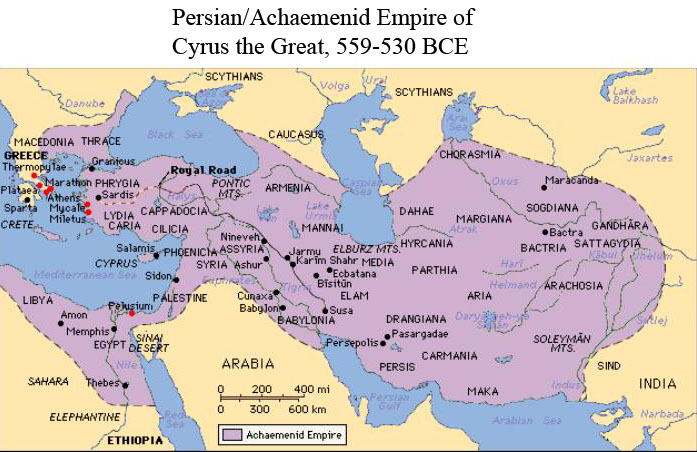
The Achaemenid Empire stretches from Libya in Africa, to Greece in Europe, to Georgia, up to the Caucasus mountains, and to the East as far as the Thar Desert in Northern India. It does not reach anywhere near China, as some people claim to be part of the empire of Zul Qarnain.
The next verses of the Quran to look at are the following:
So he travelled a course, until he reached the setting of the sun, which appeared to him to be setting in "حَمِئَةٍ" [sludge or mud or clay] where he found some people. We said, “O Ⱬul-Qarnain! Either punish them or treat them kindly.” (Quran 18:86)
This verse is taken to mark the Western end of the empire of Cyrus. This would be the Aegean Sea, to the West of present day Turkey. Between the Aegean Sea and the Black Sea, lies the Marmara Sea.
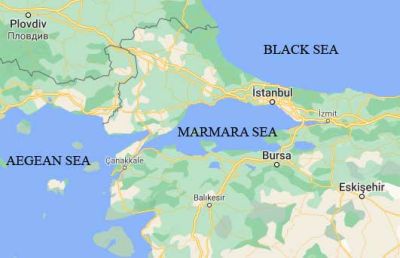
At certain times, the water of the Marmara Sea looks like mud. This is caused by “marine mucilage” that is produced by certain microorganisms. It is called "sea snot".
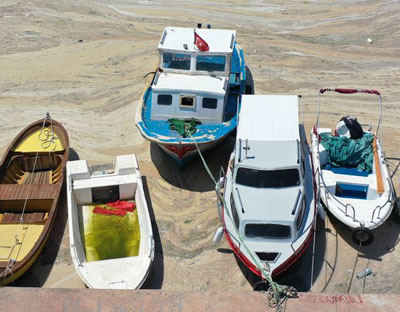
The boats in the above photograph appear to be on land but are actually in the Marmara Sea, with the water looking like mud.
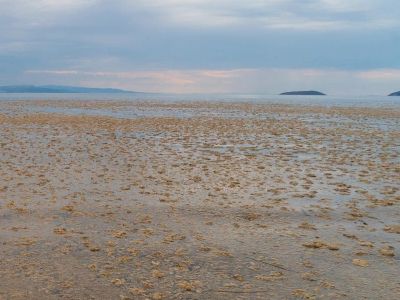 It may be that when Cyrus visited the Marmara Sea, the sea snot was present as far as the eyes could see. This must be the meaning of verse 18:86.
The next verses to be considered are the following:
Then he travelled a [different] course until he reached the rising of the sun. He found it rising on a people for whom We had provided no shelter from it. (Quran 18:89-90)
Again, notice that no mention is made that the place of the rising sun must be the Eastern-most part of the world.
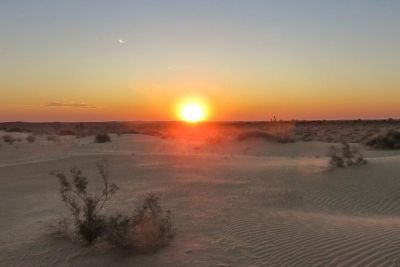
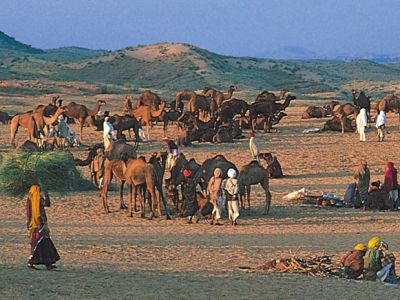
What is mentioned is a place where the sun can be seen rising from the horizon, and there is a desert of some kind in the area (no shelter from the rising sun). It would mean the Thar desert, the Eastern most edge of the Achaemenid Empire.
Here is what sunrise looks like in the Thar desert:
And here are some people who live in the Thar desert:
So, the above verses define the Western and Eastern borders of the kingdom of Zulkarnain, and they match those of the kingdom of Cyrus the Great.
The Two Mountains
Next verses to look at are the following:
Then he set out on another expedition until when he reached a place between the two mountains, he found beside the mountains a people who scarcely understood anything. (Quran 18:92-93)
After defining the Western and Eastern limits, the next direction must be North, because South would be Persia, home of Cyrus. The "two mountains" must refer to the Caucasus Mountains to the North of Georgia. The two mountains are separated by a narrow gorge, called the Dariel Gorge:
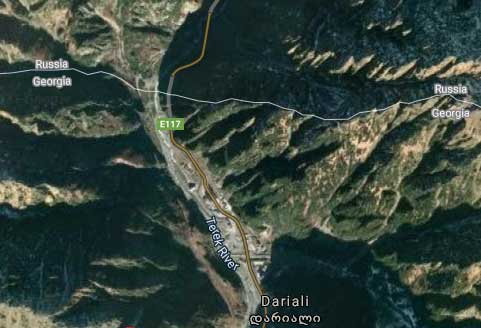
The sides of the gorge are very steep and are a few hundred meters high, making it impossible for someone to climb it.
The verse also mentions "a people who scarcely understood anything".
Georgia has a language that is based on the Kartvelian dialect. Even until now, all attempts to prove a genetic link between the Kartvelian languages and any other language family in the world have failed to gain acceptance in mainstream linguistics. In other words, the language is unique (although today, many foreign words have been absorbed into the Georgian language). The uniqueness of their language would have prevented them from understanding whatever is said in another language, including the Persian language that Cyrus would have used.
However, there must have been trade going on between Georgia and the other parts of the Achaemenid Empire, and there must have been locals who could speak the Persian language.
Gog and Magog
The next verse of the Quran mentions Gog and Magog:
They said: "O Zul Qarnayn, Gog and Magog are spreading corruption in this land. So shall we pay you taxes on the understanding that you will set up a barrier between us and them?" (Quran 18:94)
If we consider the Achaemenid Empire as a whole, the only place with two mountains and a pass in between is the Dariel Gorge. There used to be a gate there (yes, Zul Qarnain's iron wall no longer exists) that has been wrongly referred to as the Gate of Alexander. Josephus, a Jewish historian in the 1st century, is known to have written of Alexander's gates, designed to be a barrier against the Scythians. According to this historian, the people whom the Greeks called Scythians were known (among the Jews) as Magogites, descendants of Magog in the Hebrew Bible.
Concerning the war of Gog and Magog, verse 2 of Ezekiel 38 of the Jewish scriptures states:
בֶּן-אָדָם, שִׂים פָּנֶיךָ אֶל-גּוֹג אֶרֶץ הַמָּגוֹג--נְשִׂיא, רֹאשׁ מֶשֶׁךְ וְתֻבָל; וְהִנָּבֵא, עָלָיו.
(Son of man, set your face toward Gog, of the land of Magog, the chief prince of Meshech and Tubal, and prophesy against him)
The Jubilee Bible5 (not included among the books of the present Bible) describes the land of Magog to be the land that is North of the River Don, East of the Azov Sea, to the North of the Caucasus mountains, all the way to the Chukchi Sea and Bering Sea in the East, between Russia and Alaska. Mongolia and Kazakhstan lie to the immediate South of this region. In other words, the land of Magog is Russia.
The Jubilee Bible further describes the land of Meshech as North America, and Tubal to be Western Europe, including Portugal, Spain, France and possibly other neighbouring countries. These are the regions of the world that will play a major role in the Gog and Magog war against Prophet Isa and his followers in the end-times.
Identity of Gog and Magog
Let us now consider a hadith concerning Gog and Magog:
"You say there is no enmity, when in fact you always fight the enemy, until Gog & Magog come; they have a wide forehead, narrow eyes, lit hair; they descend quickly from all high places, their faces like hammers". (Musnad Imam Ahmad 5:271)
The description in the hadith would fit the following person perfectly well:
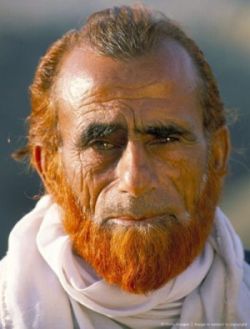
The above picture is of an ancient Western Scythian - the nomadic tribe that lives North of the Cucasus mountains, as shown in the map of the Achaemenid Empire above.
The Scythians were mighty warriors who were scared of no one. The Greek historian Herodotus, in his Histories (Book 4, 5th century BC), wrote: "None who attacks them can escape, and none can catch them if they desire not to be found". Perhaps this is the reason why Zul Qarnain chose to build a wall of iron, instead of going after them and having to fight a very hard battle. Later, the third Achaemenid King, Darius the Great, tried to attack the Scythians by entering Eastern Europe through Thrace, and crossing the Danube. They managed to get as far as the Sea of Asov. The Scythians evacuated their civilians and livestock to the North and adopted a scorched earth strategy, while simultaneously harassing the extensive Persian supply lines. Suffering heavy losses, the Persians eventually retreated across the Danube, back into Persia.
Availability of Iron and Copper
Let us now get back to the iron wall of Zul Qarnain. The Quran states:
Bring me ingots of iron." Then after he had filled up the space between the two mountain-sides, he said: "(Light a fire) and ply bellows." When he had made it (red like) fire, he said: "Bring me molten copper which I may pour on it." (Quran 18:96)
We now need to verify whether the Georgian region has had a significant deposit of iron and copper in the past.
According to "ANCIENT GEORGIAN IRON METALLURGY AND ITS ORE BASE" by David M. Kuparadze1, Dimitri V. Pataridze1 and Thomas N. Kerestedjian6,
Southern Georgian metallurgical centres are considered the birth place of the iron metallurgy of the world and have played leading role on the markets of the then known world during the whole Antiquity.
The same report goes on to state:
During the Antique Period the Georgian South used to produce iron, copper and copper alloys, gold and silver. This is registered in Greek and Roman written sources describing the metallurgical skills of the Mossinik, Halib and Tubal protoGeorgian tribes.
The Antique period lasted between the 8th century BC and the 6th century AD. The rule of Cyrus was within this time period.
All the above information is in agreement with Gog and Magog being the Western Scythians who lived to the North of the Caucasus Mountains, in what is today Russia. But they can no longer be found there. They have migrated mostly to Western countries.
The Khazars
The place where the Scythians lived were later taken over by the Khazars, who adopted the Jewish religion, then moved to Israel and are today's rulers of Israel.
To find Gog and Magog, find the descendents of the Western Scythians.
References: